Tuesday, March 15, 2016

NPB 2016 Season Outlook: Pacific League


The Pacific League came off a season where it dominated the Central League head to head. Talent is not a problem,

In our Lions OenDEN podcast episode, we discussed the league in audio format, but here is our breakdown of everyone including the Saitama Seibu Lions.

Overview: 

Most people are going to say it's all about one team and the rest of the league is playing for the losing rights to them. Understandably, the talent in one area has a larger gap than the rest.  The last playoff spot is up for grabs, but the consensus is that there is one great team, one good team, and the rest are fighting for positioning.

===

Fukuoka Softbank Hawks

The defending Japan Series champions are looking for a three-peat. They lost Lee Dae-Ho, but have plenty of talent to make up for this.

Strengths: Rotation, bullpen, power hitting, defense, depth

An argument can be made that they're well-rounded everywhere on the roster. Softbank is also one of two teams to have a third-team at the ikusei level where they develop guys. The rotation was already rich prior to 2015, but Rick Van Den Hurk gave them another jolt for the second half. They can afford to play an eight or even 10 man rotation if they want to.

Offense has the reigning MVP in Yuki Yanagita while 3B Nobuhiro Matsuda returned after considering a jump to MLB. While the power production could go down with Lee in MLB, there shouldn't be a problem getting on base and hitting for average with the load of talent they have.

Weaknesses: Hangover? Stranding runners

If we want to be picky, the catcher position is a hole offensively with Toru Hosokawa and Hiroaki Takaya. There are close games they have lost due to stranding runners on base, but this also means they are still a threat no matter how bad they play.

Signings: P Tsuyoshi Wada (returning from the Cubs), P Robert Suarez

Expectations: Some people are already booking their tickets to Fukuoka in October. The level of talent compared to the rest of the Pacific League is unmatched and they have what it takes to win again. The rotation doesn't have many ace quality starters, but the depth of No. 2 pitchers is fine. It's also helpful to inflate some power numbers with a fence that's moved in, making it easier to hit home runs.  It should be unanimous among prognosticators that the Hawks finish in first place.

===

Hokkaido Nippon-Ham Fighters

After having a decent 2014 season where they won a playoff series, some thought 2015 would be where they fall back to earth. Instead, they took a leap and established themselves as the second best team in the Pacific League.

Strengths: Hitting, speed, defense

The Fighters have plenty of guys who can get on base from Daikan Yoh, Takuya Nakashima, Haruki Nishikawa and a very young Daiki Asama. They even have power hitting with Sho Nakata and Brandon Laird, who both had at least 30 HRs last year.

They make teams pay when they're on base, stealing at will with the speed they have on the roster. There's plenty of youth combined with great defense in the field, meaning they can never be written off. Kensuke Kondo is also one of the better kept secrets in Japan, where he would also hit for average and do well among catchers.

Weaknesses: Rotation and bullpen depth

Shohei Otani gets all the attention for being the most talented pitcher in Japan, but do they have quality depth behind him? Luis Mendoza is respectable, Mitsuo Yoshikawa is a one-season wonder, Kohei Arihara is the reigning Pacific League rookie of the year by default and their new signing Anthony Bass is an uncertainty. There's some good middle rotation pitchers, but can there be a quality No. 2 behind Otani?

As for the bullpen, they will need better depth to take over before Hirotoshi Masui comes in to close. It's a sketchy middle relief unit and they'll need to hope some of their younger players improve for 2016.

Foreign signings: P Chris Martin, P Anthony Bass

Expectations: The Fighters are a good team who can display a great use of fundamentals on the field. Can they be a great team to challenge the Hawks? That question will remain for the season as their rotation and bullpen need to get better in order to compete at a championship caliber level. Hideki Kuriyama is a very smart coach and knows how to get the most out of his players.

===

Chiba Lotte Marines

The Marines were projected as a bottom tier team last year, but shocked many by finishing in third place and winning a playoff series against the Fighters. Was last year a fluke or do they build upon the decent year they had given their expectations?

Strengths: Roster balance, Outfield

The Marines are a team with depth where there are no significant holes in the lineup. Their outfield had a great season from Ikuhiro Kiyota and a consistent year from Katsuya Kakunaka. There's plenty of players to use in the outfield, but only three can play at once.  Their rotation also has balance with a solid year from Ayumu Ishikawa and a rebound season from Hideaki Wakui. Jason Standridge also provides stability in the middle while the back end isn't too shabby either.

Weaknesses: Lack of great players

This isn't taking away from what they did in 2015, because they have above average players on the roster. The question is, do they have championship level players on their roster? They're going to be rebuilding on the infield by getting younger with guys like Taiga Hirasawa and Shogo Nakamura taking over. Chiba let Luis Cruz and Toshiaki Imae walk in order for the rebuild (or possible reload) process to begin. Yamaico Navarro should also contribute to the power numbers when he gets back from his suspension, but the defense could take a hit with the raw players on the infield. Ishikawa could be established as an ace, but their rotation has mostly No. 3 or No. 4 pitchers at best and it's uncertain if Wakui can repeat the season he had in 2015.

Signings: IF Yamaico Navarro, P Jason Standridge

Expectations: Chiba should be in contention for the third playoff spot, but it's doubtful they can overtake the Fighters or Hawks in the regular season. There's enough talent to not be in the cellar, but is it good enough to be in the upper echelon of NPB teams?  They can finish anywhere from third to fifth. One thing is for sure: No one would want to see them in a best 2 out of 3 series.

===


Saitama Seibu Lions

The Lions had a great start to the first half of 2015, but a record-breaking losing streak of 13 losses combined with mediocrity did them in.

Strengths: Power hitting, Defense

The Lions have plenty of pop with Takeya "Okawari-kun", Ernesto Mejia, Tomoya Mori and Hideto Asamura all capable of hitting a least 20 home runs for a season. It's possible that new 1B Hotaka Yamakawa can be another power threat in the lineup. Can Shogo Akiyama have a similar year for 2016 after a record-seeing single-season hits record established?

Outfield arm strength shouldn't be a problem, but range could be a small issue for the right fielder. Infield defense is mostly good, but shortstop could be raw with Shuta Tonosaki taking over at SS.

Weaknesses: Rotation depth, bullpen uncertainty

The back end of the rotation overachieved statistically without Takayuki Kishi for two months. However, talent and opposing teams adjusting caught up to them in the second half. Tomomi Takahashi did terrible in the closer role and lost his job by the time the season ended. When the back end of the bullpen was a strength to start, everything fell apart when there was no closer and middle relief was already a problem.

An argument can be made where the defense won games and the pitcher's job was to put the ball in play. They were dead last in striking out opposing batters last season.

Signings: RP C.C. Lee, SP Andy Van Hekken, IF Shogo Kimura

Expectations: The Lions have the offensive power to do damage against anyone, but the pitching staff is too much of a concern to many. If they can pitch like they did in the first half of 2015, there's a chance they can make noise in 2016. It will be up to the bullpen as a factor to make or break them this season. This also has the making of a lame duck type of season for manager Norio Tanabe, where they have Tetsuya Shiozaki lined up to take his spot.

===

Orix Buffaloes

The Buffaloes had a load of expectations in 2015, but it all crumbled with a high number of close losses, resulting in their manager being forced to resign in the middle of the year. They promoted Junichi Fukura, who was their head coach (bench coach equivalent) as he takes over for the 2016 season. Expectations could be lowered for 2016 after they signed a lot of free agents the previous year.

Strengths: Rotation

Chihiro Kaneko, Yuki Nishi and Brandon Dickson are an impressive Big 3 for a rotation. Even Daiki Tomei should be a respectable middle rotation starter. With three pitchers who are capable of being aces, they will remain in games and stay competitive.

Weaknesses: Bullpen, inconsistent offense, defense

The bullpen blew several games in the first half and the team was playing meaningless baseball by the time it was June. A minor issue is attention to detail, where it's one error or one at bat as the team comes up short in a game. There's talent on this team to do damage, but Yoshio Itoi and Takahio Okada had down years. If Masahiro Nishino and Tony Blanco are healthy, it will bolster their offense.

Foreign signings: IF Brent Morel, OF Brian Bogusevic, P Pat Misch, P Erik Cordier

Expectations: Orix has a new wave of foreigners on the roster, but not all of them will be playing with Dickson and Blanco expected to be two of the four spots allowed. This team should compete for the postseason, but can they get it together on offense let alone defense? The rotation carried them in 2015, which is why they can't be written off in 2016.

The reason they can't be trusted is Fukura as a manager. Like the Lions, putting the pieces together has this as a lame duck year with Fukura as a short term solution. So Taguchi is currently the farm manager and it's possible that this is a "caretaker" type of season as a transition so he could be the next in line.

===

Tohoku Rakuten Golden Eagles

The Eagles are entering a new era with Masataka Nashida as their new skipper. Some may view this as an unattractive hiring, but he is capable of turning things around. Previously, they had a younger manager in Hiromoto "Dave" Okubo, who cost them games by trying to steal bases with the wrong personnel. Since winning the 2013 Japan Series, the Eagles haven' recovered after losing several players from that team.

Strengths: Back end bullpen

Kam Mickolio will be healthy for them and Yuki Matsui will remain the closer for 2016. If the Eagles have a lead entering the 8th and 9th innings, they should secure a win on paper.

Weaknesses: Offense, rotation depth

Rakuten had the worst offense last season among Pacific League teams. The level of talent was an obvious issue, but there could be improvements if Nashida's approach works. Rotation depth is flawed outside of Takahiro Norimoto and there isn't much supporting cast.

Signings: IF Toshiaki Imae, IF Japhet Amador, OF Jonny Gomes, P Radhames Liz, P Jake Brigham

Expectations: Imae should help them offensively and there is plenty of foreign options to choose from. But like Orix, they won't be able to play them all with Kenny Ray in their rotation, Mickolio in the bullpen and Zealous Wheeler being part of the infield. They need to hope Ginji Akaminai is healthy while their first round draft pick Louis Okoye should be intriguing.

Nashida is a smart manager who can improve the team offensively as his track record shows with the Fighters. However, 2016 will be a year to focus on individual performances as they won't have the personnel to compete in the short term.

===

Here's our breakdown featured on the Lions OenDEN podcast episode.

Central League breakdown

===

Follow us on Twitter @GraveyardBall 

Sunday, March 13, 2016

English NPB media predicts the Seibu Lions for 2016


Japan Baseball Weekly released their Podcast episode previewing the Pacific League for the 2016 season on Sunday (in USA time). You can listen to the full episode here.

John E. Gibson of the Japan News, One World Sports and Yomiuri Shimbun, Jim Allen of Kyodo News, Claudio Rodriguez of Béisbol Japonés and Jason Coskrey of the Japan Times discussed everything regarding the Pacific League with projections in the standings.

Where did they have the Lions?  We'll show you where they have them finishing in the Pacific League with a few notes of what they said. (Full prediction articles from Gibson and Coskrey will come soon.)

===

John E. Gibson (@JBWPodcast): 5th

-Solid rotation, but not high on Yusei Kikuchi

-Drafting 8 pitchers tells him that they don't have good pitchers in the system

-Strengths: Power hitting and Shogo Akiyama

-Weaknesses: Poor defense, strikes out too much, lack of speed, low quality outfield arms

-Team has a bunch of designated hitters leading to bad defense

===

Jim Allen (@JballAllen): 4th

-Lions should have Tomoya Mori play in the outfield just so his bat is in the lineup.

-Likes the hiring of Hideki Hashigami as a tactics/strategy coach.

-Confirms our theory that Tetsuya Shiozaki is in line to be the next manager after Norio Tanabe in 2017. Shiozaki was promoted from ni-gun manager to being the head coach (MLB equivalent of bench coach in Japan).

-Lions farm team is a "pitcher's graveyard".

-Very close to being in third place. (He has the Marines finishing in 3rd)

===

Jason Coskrey (@JCoskrey): 3rd

"If the Lions can hit as far as hitting home runs / extra base hits, they're gonna be fine. In games where the balls [aren't] finding holes or over the fence, they're not going to be able to manufacture runs because they're slow. They might have a tough time in that area, but I think their offense is going to be fine."

"Their pitching staff is a worry a little bit for me, [Takayuki] Kishi is solid. I have always liked Kikuchi. I think he really started to show a little bit more last year."

-Reports say Kikuchi is adding a changeup to his arsenal this year.

-Kona Takahashi is going to get a "trial by fire" for 2016. It will be a be a test to see how he does with a full workload.

-Has issues with Ken Togame, due to not having two consecutive seasons of being productive. (Togame has been up and down and not pitched two seasons of 100+ innings).

-Nogami is not particularly great, flawed back end rotation, bullpen is not impressive. Thinks they'll lose a lot of close games.

-Has the Lions finishing 3rd because he believes the rest of the Pacific League is weaker.

===

Claudio Rodriguez (@BeisbolJapones): 5th

-Unsure about the new foreign pitchers in C.C. Lee and Andy Van Hekken

-Likes the Lions' offense

-Not convinced with the team's rotation

===

Other Predictions: 

Michael Westbay (Data / behind the scenes for JBW Podcast, Founder of Japanese Baseball): 6th

Wayne Graczyk (Japan Times Columnist): 3rd

Patrick Newman (@npbtracker): 3rd

@NPB_Reddit: 6th

Kenichi Yazawa (Former Chunichi Dragons player, TV analyst): 2nd

Norihiro Akahoshi (Former Hanshin Tigers player, TV analyst): 4th

===

Follow us on Twitter @GraveyardBall

Saturday, March 12, 2016

Tanabe Ends Mori's Catching Experiment

The Lions' hitting prodigy will no longer be spending time behind the plate. 
After lots of experimentation, the Lions ended all the dreams of those who watched the 2013 Summer Koshien for the 2016 season. It was in that tournament that a teenage Tomoya Mori inserted himself into the national spotlight as Osaka Toin's catcher. Catching teenage superstar, Shintaro Fujinami, many remembered the two-way potential of Mori and expected him to make the leap to more time behind the plate in his age 20 season.

Instead, Lions manager Norio Tanabe prioritized the experience and stellar defensive reputation of Ginjiro "Gin-chan" Sumitani over the opportunity to mold Mori into the full-time catcher. There's no doubt that the Lions are a team that has the personnel that should look to win now and this move is one that speaks to that line of thought.

Mori has already proven that his power is something that needs to be in the lineup every day. Especially, after posting 17 home runs in his age 19 season, but moving him to a role behind the plate could take a toll on his offensive numbers while at the same time being forced to deal with a downgrade in defensive value.

Moving Mori away from the backstop is the right move for the reasons stated above. Power is at a premium and when it comes to the development of a young hitter, there's no need to over-complicate things by giving Mori a massive amount of workload when it's his bat that makes him so special as a player.

This story isn't much of a groundbreaker as it means more for the rest of the squad now that Mori fits with only a few positions. With the earlier reports that the Lions were looking to move Takeya "Okawari-kun" Nakamura to DH to keep him healthy, the questions remain. How many games will Okawari-kun play at DH and 3B? In addition to, how many games will Mori play at DH, RF, and even 1B?

Regarding body type, Mori could profile as an RF, especially with his strong arm not to mention that he's not like other former catchers who are big and bulky. His rather compact profile of 5'6", 176 pounds (170 cm, 80 kg) allows for one to imagine him developing a good deal of range. It's clear that Okawari-kun needs to play a lot more games at DH, but flexibility is never a bad thing and allowing Mori to DH and Nakamura to play third here and there makes Tanabe's job a bit more interesting.

Best case scenario is that Mori holds his own in RF and nails down a position that has been a revolving door for the Lions. What might be the wildcard in all of this is the fact that Shogo Akiyama's range in CF is above average, which would help make Mori's task in RF a lot less daunting.

Worst case scenario is that Mori struggles to make the routine plays in RF, creating a crisis in confidence for the 20-year-old. In addition to poor fielding, Mori's bat may continue to struggle to the pitchers finding more ways to get him out. These issues would force Tanabe to use Nakamura at third a lot more than previously planned and that may turn out just fine, but with Okawari-kun's history of injuries, the worst could be a death blow to this Lions squad in 2016. 

The question of where Mori should play is a situation that we will be looking at quite closely when the season rolls around. Overall, I applaud Tanabe's decision to put more value in Mori's power, while also valuing the fielding prowess of Gin-chan.

===

Other note: 

-Mori was diagnosed with a bruise after being hit by a pitch in an exhibition game on March 12.  

===

Follow us on Twitter @GraveyardBall

Wednesday, March 9, 2016

2016 NPB Season Outlook: Central League


With the 2016 NPB regular season upon us, it's the time of the year where people make predictions as well as write every thought they have regarding the new season. For us, this is no different as we spoke about the Central League at the end of our Lions OenDEN podcast episode.

Here is our breakdown of how we see the Central League as a whole with strengths and weaknesses for each team:

Overview: 

Last year, the Central League was mediocre from top to bottom after Interleague play, as every team had a losing record at one point in the second half. Some can make the argument for balance, but in reality, each team had too many flaws to pull away until September. The Tokyo Yakult Swallows were the best of the bunch as they won the pennant (regular season title in Japan's terms).  

Hitting was down, meaning pitching stats were rather inflated by Central League standards. Majority of parks in this league are hitter friendly, but the pitching ruled last year. Expect changes for the upcoming season.  

===

Tokyo Yakult Swallows:  

As earlier mentioned, the Swallows pulled away from being the "best of the worst" in the second half thanks to a great bullpen and offense. They had plenty of talent in 2014, but were in dead last due to a handful of injuries and bad luck. They made the turnaround of being worst to first in the Central League.  

Strengths: Bullpen, Offense

Yakult has the reigning Central League MVP in Tetsuto Yamada, who is coming off a season with "triple 3's" consisting of 30+ HRs, 30+ stolen bases and batting over .300 for the year. There's plenty of other talent including Shingo Kawabata, Yuhei Takai, a solid catcher in Yuhei Nakamura  Coming back from an injured season is Wladimir Balentien, who hopes to get redemption in 2016. 

For the bullpen, they lose Tony Barnette as he joined the Texas Rangers, but they have plenty of options for Mitsuru Manaka to choose from. Logan Ondrusek worked out well as a new import, Ryo Akiyoshi and Kentaro Kyoko could be candidates to close it out. There are also guys downstairs who can contribute.  

Weaknesses: Back end rotation depth

The Swallows front line starters were solid in Yasuhiro "Ryan" Ogawa and Masanori Ishikawa, but the back side is questionable. Of course this is to be expected when the Swallows play in a hitter friendly ballpark. Veteran Shohei Tateyama returned from his third Tommy John surgery last year and was respectable when coming back. They also had a decent pickup in Hirofumi Yamanaka, who was a side arm pitcher that was hurt.  

Foreign signings: P Luis Perez, P Josh Lueke, P Kyle Davies

Expectations: The Swallows have the talent and depth to repeat again in the Central League. If there are no significant injuries, they should be a lock for the postseason. It's even a bonus if their foreign pickups can help their bullpen or rotation. 

===

Yomiuri Giants

The Giants no longer have Tatsunori Hara as their manager, as he stepped down after the team was eliminated in the Climax series. Longtime player Yoshinobu Takahashi has retired from playing and became the manager going forward. 

Strengths: Front line rotation and depth

The Giants hit a home run with their import signings last year in Miles Mikolas and Aaron Poreda immediately contributing to the rotation. The latter was a respectable No. 3 while Mikolas had an ace-like season to carry them. Tomoyuki Sugano still remains an ace. For hitters, there are plenty of options for Takahashi to choose from. The Giants high payroll allows them to stash talent, but who comes in? Luis Cruz was one of their big pickups as the Chiba Lotte Marines let him walk.  

Weaknesses: Middle relief, inconsistent hitting, manager uncertainty

The Giants had a down year offensively when there was plenty of talent on the roster. Things are bound to come up. Meanwhile, the middle relief was shaky before their closer Hirokazu Sawamura could come in. For Takahashi, he will have to learn on the fly even though he was a part time coach/player last season. As someone who played under Hara for his career, he should have some good tips on managing games.

Foreign signings: OF Garrett Jones

Expectations: Ryota Wakiya and Cruz were their big signings for the infield. If they can string offense together and rebound from a down 2015 season, they have what it takes to win the Central League. By name recognition alone, they are expected to make the postseason and have the rotation to do it.  

===

Hanshin Tigers

The Tigers are also entering a new era, with a change in the front office after the passing of Katsuhiro Nakamura in the middle of last season. They let their manager Yutaka Wada walk, hiring Tomoaki Kanemoto, who was doing color commentary in the broadcast booth after retiring as a player. This was an expected hiring from my spectators and sounds good on paper, but we will need to wait and see before we make any judgements. 

Strengths: Front Line rotation

Shintaro Fujinami and Randy Messenger are a great 1-2 punch. This could be the season where Fujinami establishes himself as possibly the best pitcher in Japan. Minoru Iwata and Atsushi Nomi were also serviceable in the middle.  

Weaknesses: Bullpen and manager uncertainty, offense

The Tigers rode a hot streak to get to the 2014 Japan Series, making the front office have the vibe that they were a contending team. In reality, they had a lot of close wins where everything went their way. Last season, this caught up to them as they had a season of mediocrity offensively. Kosuke Fukudome (yes, he's still playing) was the bright spot.  

They let longtime OF Matt Murton walk, leading to some new blood in the outfield. It's possible that first round draft pick Shun Takayama could make an instant impact for them. Hanshin will also need a better season from third-year import Mauro Gomez.  

The bullpen's back end was a strength with Seung-hwan Oh as the closer, but now it becomes up to their foreign signings to take the load. Oh signed with the St. Louis Cardinals in free agency and it was clear he wouldn't return after breaking a Korean law of gambling outside the country. Legal issues aside, it's possible that Oh had peaked in 2014 and the team needed a change for closing. 

This unit contributed to their poor run differential where they'd be blown out or winning close games. Like Takahashi, Kanemoto will need to learn on the fly and even he is expected some growing pains.  

Foreign signings: P Marcos Mateo, P Rafael Dolis, IF Matt Hague

Expectations: This is one of many teams with complete uncertainty everywhere from the bullpen, offense and manager. Given the competition and the strength of the Tigers pitching, they will compete, but where do they finish? Based on talent alone, they can finish as high as second and as low as fifth. If Dolis or Mateo make instant impact in the bullpen combined with what could be an improved offense, they would be in good shape for 2016. 


===

Hiroshima Toyo Carp 

The Carp came off a disappointing 2015 season where they were expected to contend for a championship. They arguably had the best rotation in Kenta Maeda, Kris Johnson and Hiroki Kuroda for a Big 3 trio. Unfortunately, we didn't get to see this in the postseason, as they were eliminated on the last day of the regular season by the Chunichi Dragons. Maeda was posted and signed with the Los Angeles Dodgers.

Strengths: Front line rotation, overall talent

 Kris Johnson and Hiroki Kuroda will still make their rotation fine. Daichi Osera is expected to emerge, after he was a top draft pick in 2013. On paper, this could be a Big 3 if Osera develops and takes the reins. The position players have talent all over the field, with Ryosuke Kikuchi, Yoshihiro Maru, Brad Eldred and even new signing Hector Luna. For a veteran, Takahiro Arai also had a respectable season.  

Weaknesses: Bullpen, inconsistent offense

Last year, the offense would score in bunches, but could get shutout at times. They would give their fans a tease with some dominant games, but couldn't go on a run to make the postseason as they stayed in mediocrity. After a great 2014 season, several players like Maru didn't hit well in 2015. 

The bullpen was the nightmare spot for the Carp, with several blown leads and losses late in the game. Manager Koichi Ogata was forced to put Osera in the bullpen to strengthen the unit as a result. 

Foreign signings: OF Jason Pridie, P Jay Jackson, P Bradin Hagens

Expectations: The loss of Maeda obviously takes a hit to the rotation, but the Carp could be a better team overall if they get consistent offense and Luna provides stability at 3B. If their bullpen becomes much improved with the help of Jackson and Hagens, we could see them looking at a playoff spot. The talent is there to still contend, but it needs to come together. This also has the makings of a hot seat season for Ogata, who has gotten some blame for last year's shortcomings.

===

Chunichi Dragons

For a team who was expected to finish in dead last and be the worst among all teams with an aging roster, the Dragons had a better season finishing 5th with respectable offensive numbers. Manager Motonobu Tanishige has retired as a player and now has full time managing duties in the dugout. The team also got younger after a transition year with several veterans retiring.

Strengths: Front end rotation, outfield

Yudao Ono and Shunta Wakamatsu made a great 1-2 punch last year and the former is one of the best pitchers in the game today. Ricardo Nanita (when healthy), Yohei Oshima and Ryosuke Hirata are also consistent assets in the outfield. Don't let their numbers fool you, they hit well for Nagoya Dome standards, which is one of the ultimate pitcher's parks in NPB.

Weaknesses: Rotation depth, bullpen

The offense wasn't the problem for a pitcher's park, but rather the rotation being half empty/half full last season. Daisuke Yamai is a respectable mid rotation guy, but there is a lack of depth where the drop off is large in comparison to their front and back ends.

Their bullpen was another weakness after Koji Fukutani couldn't make the transition from setup man to closer. Fukutani and Katsuki Matayoshi should be good for the middle relief, but who is the closer?  Shinji Tajima did a respectable job to close out the year and Tanishige will have his work cut out for him on decisions to make.

Foreign signings: P Jordan Norberto, P Juan Jaime, P Drew Naylor (midseason signing in 2015), OF Dayan Viciedo

Expectations: They lost Hector Luna and had a middle of the road offense, but they were competitive enough last season to be a .500 team. The more impressive part is how they had a winning record against the Carp (15-9-1) which knocked them out of the postseason.

Their offense could be average, but if the bullpen improves like it did in the second half of last year combined with a better rotation, they could finish in third place at best. Tanishige did a good job learning on the fly the last two seasons and given the talent he had, they weren't as terrible as their 2015 record was. It might be a stretch to say the playoffs are coming in Nagoya for 2016, but they won't be a cupcake and could provide competitive baseball.

===

Yokohama DeNA Baystars

The Baystars had a hot first half where everything went right, then they fell back to earth after losing 12 consecutive games at one point last season. This is a new era, where Alex "Rami-chan" Ramirez takes over a squad looking to make the playoffs for the first time since 1998. With the Toronto Blue Jays making the postseason, this is the longest playoff drought among teams in NPB and MLB.

Strengths: Offense, Closer

The offense usually isn't a problem in what's a hitter-friendly ballpark. Jose Lopez proved to be a great signing to provide extra pop and Yoshitomo Tsutsugo had a quality season. Takayuki Kajitani is also one of the best outfielders out there. One bright spot from 2015 was rookie closer Yasuaki Yamasaki, who was thrust into the role with others injured. Coming off a rookie of the year award, he is hoping to repeat his success from last year.

Weaknesses: Rotation, Manager uncertainty

This team has some mid rotation starters at best with Yasutomo Kubo, Daisuke Miura and a decent Shoichi Ino. They're going to need to improve their pitching if they want to compete and not be dead by midseason.  Their first half was a smokescreen of everything going right, but it won't last based on talent. Ramirez brings new life to the team, but how does he manage on the field? We will have no idea until the games begin.

Foreign signings: P Zach Petrick, IF James Romak,

Expectations: There isn't a lot to like about this team besides some individual efforts and a handful of talented players. Offensively, they have a nice core, but it won't take them far as you can't hit your way into a playoff spot. This team has a chance to get out of the cellar, but the pitching will need to improve in order to do so.

===

For our actual predictions on 1-6, here's the link to our Lions OenDEN podcast episode (listen to the last 15 minutes or so).  Our Pacific League preview can be found here.

===

Follow us on Twitter @GraveyardBall

Monday, March 7, 2016

NPB 101: Differences between baseball in Japan and MLB

Bunting has been a typical frequency in Japan, but there's more than just this.
Major League Baseball is the king league of its sport. However, Japan has put their own spin and brand of baseball in the Nippon Professional Baseball (NPB) league where we see a different identity.

There are plenty of differences where Japan has its footprints on America's past time. To get you prepared for the 2016 season, here are some differences between baseball in North America and NPB.

EDIT: We've made a Part 2 to differences between MLB and NPB after three years of watching.

===

Bunting: Japan likes to bunt more than MLB

Just to get this out of the way, Japan indeed will bunt more often than the average MLB team. Why do this and giveaway outs? Their theory is that you need to score one run in order to get two, so the manager will often be satisfied to play for one run in an inning. Some managers will have a weaker hitter bat second so that if the leadoff man gets on, they can sacrifice and move him 90 feet.

This is also done as a move to save face, because criticism will be drawn if a double play happens. If no bunting occurred in Japan, we'd see more scrutiny from the media, which is something no one wants to deal with. Even from the picture above, the batter will often show bunt if he is sacrificing.

===

Outfielders in Japan have better range and arm than their MLB counterparts

Japan puts a strong emphasis on conditioning and arm strength. This would mean 3B coaches are more cautious about sending runners home and being on second does not guarantee "Scoring position" on a ball that goes past the infield. They're also very good at getting to the ball quickly.

===

MLB has more power hitters

Power hitting exists in Japan, but not to the extent that it does in MLB. There's only a handful of players meant for pop, even though some ballparks can inflate stats due to shorter fences. Sure, there are some domestic players like Sho Nakata, Takeya "Okawari-kun" Nakamura, Yuki Yanagita and others who can mash, but it's nothing compared to the level of MLB.

===

Every run counts in Japan

This isn't saying runs don't count in MLB, but coaches in Japan emphasize each run, making defensive shifts to prevent it at all costs. If a runner is on third base with less than two outs, there's a good chance the infield will play in to try and hold the runner from scoring on a ground ball.

It's also common for the outfield to play in so there is a chance an outfield can throw someone out at the plate on a casual line drive single. Basically, you can beat the pitcher with contact, and the outfielders have no chance. Players are also taught to attack the lead runner if possible on a ball in play.

===

There are no "fastball counts" in Japan

Whenever there is a 2-0 count, sometimes an MLB pitcher will throw one down the middle just to make sure it's not 3-0. In Japan, pitchers will go with what they are most comfortable with no matter what the count is, so hitters who come over cannot expect a fastball to come. Japanese pitchers have fixated on breaking balls, whether it's a curve or a slider. It is possible that this can happen when a foreign pitcher is on the mound.

===

The "Shuuto" is a screwball with a twist

A shuuto is a heavy breaking ball meant to go inside when a right handed pitcher is facing a right handed batter and lefty vs. lefty. It's common for a hitter to whiff or even break the bat on a shuuto pitch.

===

Defense has some priorities in Japan

While earlier mentioning how much emphasis defense is in the field, Japan will take a hole in the lineup if he has great defense at the catcher and shortstop positions. It's very important to protect any fast runners and have the ability to throw them out. The shortstop will also be there for defense, but become a hole in the lineup if needed.

There can be players in the lineup at other positions for their hitting, but shortstop and catcher need to have great defense in order to survive in NPB.

===

Managers will put their closer and setup man in the 8th and 9th when they're ahead and in tie game situations

Sometimes the manager will save their closer until it's an opportunity for a save situation in MLB. Japan has more aggressive managers where the setup man and closer would take the 8th and 9th innings, respectively when the game is tied or the team is ahead. The obvious trade off is how the pitching quality becomes weaker if it goes to the 10th inning and beyond.

===

Rotations involve six players on a normal basis instead of five

Starting pitchers will usually pitch once a week on average. Typically there are six games a week with one day off, making it convenient for the manager to have six pitchers ready for starting. This is one of many adjustments that some NPB pitchers need to make if they come to MLB as part of a five man rotation. It also means that managers don't care as much about pitch count since the pitcher will have plenty of time to rest.

===

Managers will irrationally leave their starter to take the 9th inning if he can get a complete game or shutout

The manager will often go for the accomplishment besides the win in Japan. Obviously if a no-hitter or perfect game is happening, it could be like this in MLB, but the shutout and complete game is not a priority for the team. With pitch count not being a huge factor in these decisions (due to playing once a week), managers want their pitcher to go for the individual glory and sometimes they even force it. In a 2-0 type of game, if the starter is on a roll, the manager will leave him in sometimes even if there is a reliable closer available in the bullpen.

===

Coaching staffs are larger in Japan

The first-team has many staff members as coaches besides the manager himself. From head coach (equivalent of bench coach in MLB terms) to third base to infield defense to battery, there's a coach for almost everything in NPB.  This includes another coach that works on strategy. In MLB, only seven coaches are allowed to be with the manager in a single game. Some teams can have a staff member work with them before and after the game, but not while it's ongoing.

This being said, there is only one farm team in Japan, meaning there are more MLB coaches as a whole to accommodate several levels of minor league baseball combined with the top team.

===

Game planning is an important preparation in Japan

Every game is taken seriously where teams will have pregame meetings with everyone like it's a war briefing. Players will be told about the opposition and what to expect heading into the day or night. Usually the catcher "calling a good game" doesn't mean anything in MLB, but it can be a difference maker in Japan.

Coaching staff members will do their research on tendencies from the opponents besides showing film and looking at sabremetrics.

===

No managing (or coaching) experience is required to be a manager in Japan

Several people hired for a manager job will be people who've understood the game of baseball for a long time as a player. Managers are usually just thrown into the fire and the upstairs front office will just see what he does and the man can learn on the fly.

An example is how Kimiyasu Kudo, a great player and now Hall of Famer was hired after he was a television analyst for multiple years post-retirement. Kudo's connections presumably brought in a staff which has made large contributions to the team's success. Tomoaki Kanemoto of the Hanshin Tigers is another manager who has no coaching experience, but was hired after being a radio color commentator. He was a great player during his time and has plenty of connections, but no one will know what he will be like until he's on the field.

There are also teams who will go with someone foreign like how the Nippon-Ham Fighters hired Trey Hillman and Bobby Valentine is remembered for his time with the Chiba Lotte Marines. Recently, a great former player in Alex Ramirez was hired by the Yokohama DeNA Baystars after he had minimal coaching experience in Japan.

Majority of American sports teams and universities will hire someone with experience as an assistant or former head coach. It will be very rare to hire someone without past coaching on their resume.

===

Bat flips happen all the time and no one gets angry about it


Bat flips don't always happen because a home run is imminent, but sometimes it's an art of letting go of the bat. Pitchers won't get angry over this as it isn't viewed as a taunt.

===

Instant replay in Japan has been expanded to home runs and plays at the bases, but no challenges

This is a new thing about instant replay being expanded, where previously only home runs were reviewed. The one cool aspect about this, is how the umpire will just go on a stadium microphone and formally address the crowd what the ruling is. A video of this can be seen below.


UPDATE: Replay has been expanded to a challenge system and plays on base or at the plate. Still, the umpire will formally explain the ruling on a microphone like it's football.

===

Double headers are extremely rare

Games will be rained out in Japan due to the inconsistent weather all year around. However, it would be too informal to play a double header the next day as it would interfere with schedules for others. Japan is so polite, where if a train is delayed by even one minute behind schedule, they will have an apology letter for any salarymen aboard.

Makeup games will happen on blank dates and when interleague play concludes, there is nearly a full week of no games leaving a window open to play the ones rained out. Most make up games will happen at the end of the year while others can happen during the season on a blank day.

===

Tie games exist in Japan


In contrary to this movie clip, regular season games will end in a tie after 12 innings if both teams have the same number of runs. It becomes 15 innings as a limit once it's the Japan Series. If somehow the Japan Series is tied 3-3-1, there would be a rare Game 8, where there would be no inning limit to end the season.  So the home team can "Celebrate" at least a tie in the event they get through the top of the 12th inning unscathed.

Like MLB, games become official after five innings and can be called if it's raining. If the score is tied after five innings and the weather is not good enough for a game, it will be decided by the umpires.

===

The First pitch in Japan is marketed where everyone including players will watch


The entire crowd will watch the first pitch and mascots will often accommodate the person who throws it. Even the leadoff hitter (usually for the opposing team) will swing and miss on purpose no matter how good or bad the first pitch is from the plate.  A full collection of first pitches can be seen here.  

===

Crowds in Japan have a cheering section, cheerleaders as well as a visitor's section

The Oendan (cheer section) is at every game for each team. The etiquette is that cheer songs will be played when your team is batting, while the opposing team will get their chance when your team is on defense. There are also "Chance songs" when there are runners in scoring position and fans want more runs.  In MLB, you can only get consistent drums from more than one person in the Oakland A's bleachers

It's similar to college sports, where a visitor's section is in the opposite bleacher section. So even on the road, songs will be played for opposing teams while the home crowd is silent.

===

The 7th inning stretch has balloons and a cheer song instead of "Take me out to the ballgame"


Every team will sing their "cheer song" during the middle of the 7th inning. Most stadiums will have balloons for people to hold and release which is a tradition. Others will have towels or umbrellas, but 3/4ths of NPB will have balloons. Some fans will also save the balloons (I know, the appearance is a little different) for the end as a symbol of victory.  This segment is also known as "Lucky 7".

For visiting fans, they will play the road team's song at the end of the sixth inning for towels/balloons to occur.

===

Select regular season games in Japan are played in rural or suburban areas

This type of thing is fan service as people from all over the country like baseball. It's a nice convenience so that fans don't have to make a long trip by car, train or plane to see their favorite team. Teams like the Rakuten Golden Eagles and Hokkaido Nippon-Ham Fighters cover a large region of their area, meaning they play several different stadiums away from their traditional home.

In the Hanshin Tigers case, they must play some home games at the Orix Buffaloes home in nearby Osaka as two Koshien tournaments have priority in their traditional stadium. It's all but guaranteed that a fraction of road or home games will not be at the their usual home stadium. 

===

The pitcher is allowed to play catch in front of his dugout when his team is batting

If a pitcher is coming back for another inning out of the dugout (most of the time the starter), he can play catch and warm up a few tosses in preparation for returning to the mound. In MLB, this is rare and usually the pitchers will need to go to the bullpen or wait until the frame is over for this to happen. This is also a way of telling the crowd of who is expected to pitch the next inning.

UPDATE: This rule is likely to be taken away after the 2018 season.

===

Umpires get excited to call a Backwards K (Called strike 3)


Some umpires throw an uppercut or a big cross when calling a strikeout.  Best yet is when there's a fast punch.

===

Majority of bullpens are underground or indoors and require cameras for the dugout to see

Some bullpens are outdoors and visible along foul territory, however, many of them are inside or underground in the outfield area. Managers (or another coach) will eyeball the monitor they're given in the dugout to see how their pitcher looks. Sometimes the bullpen is so far away where it requires a car to get the pitcher to the mound out of the pen.

===

Half of NPB will play their traditional home games indoors

Despite nature and sun being a great aspect of baseball, domes have their purposes in Japan due to the inconsistent weather. Six of the 12 teams have a domed stadium with one of them being a retractable roof. However, that retractable roof stadium only plays a handful of games outdoors when it's prescheduled, as they won't open it without notice.  

==

Players who retire will go through a special ceremony at the end of the season


If a player spent significant time on a first team in NPB and it will be his last season, he is given a special retirement moment of glory in his last game. Usually the season is mathematically over and players will get one last hurrah whether it's one at bat for a position player or one final batter to face if he's a pitcher. The video above shows former Los Angeles Dodgers, Boston Red Sox and Arizona Diamondbacks pitcher Takashi Saito given his final batter as a player. He got a final toss after the game.

===

There you have it.  Hopefully this will draw some guidelines and what to expect for NPB when you start watching for the first time. We even have a second part to this piece.

===

Follow us on Twitter @GraveyardBall
Saturday, March 5, 2016

Graveyard Baseball Podcast: Lions ŌenDEN Episode 6

This is the sixth episode of Lions ŌenDEN.

In this episode, we talk about the Saitama Seibu Lions by each position. We also discuss the outlook of Norio Tanabe, Kazuhiro Kiyohara's arrest and previewing the entire Pacific League. As a bonus, some talk on the Central League is also here.

We apologize for any mispronunciations and errors. This was recorded partially from a public library, where the background noise has other conversations. Thanks again for listening.

Be sure to provide any feedback in the comments if possible. Click here if the embed doesn't work.


Corrections:

-Yuki Matsui is a solid closer for Rakuten and the back end of their rotation will be upgraded with Kam Mickolio being healthy.

-The Lions went 6-17-2 against the Hawks last year.

===

Follow us on Twitter @GraveyardBall
Wednesday, March 2, 2016

NPB 101: Designating for assignment and farm teams

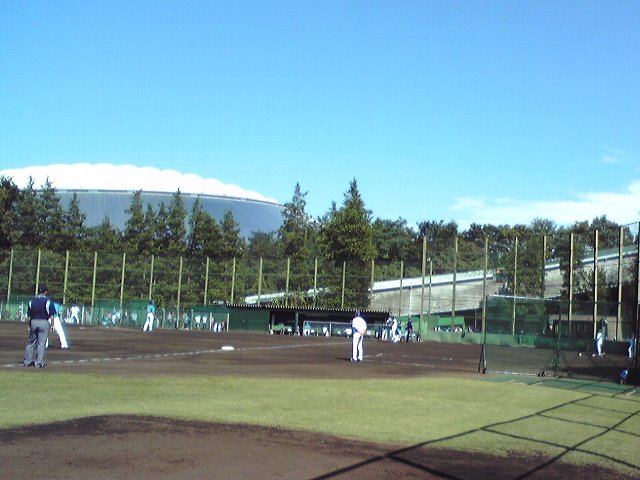
The Seibu Lions farm stadium is next door to the Seibu Dome (as seen behind)
With baseball season just around the corner, there are plenty of different rules to be made known for NPB in comparison to MLB. The big one is how the top team (ichi-gun or first team) roster is in comparison to the farm team (ni-gun or second team).

There are is only two teams in NPB per club, where the ichi-gun has a 28-man roster and the farm team carries the rest in ni-gun. The farm team also has the same name and uniforms of their parent club. The only difference is how the division alignment is by geography where it's divided by the Eastern and Western Leagues in comparison to the Central and Pacific.

All five Kanto (greater Tokyo) area teams (Yokohama DeNA Baystars, Saitama Seibu Lions, Chiba Lotte Marines, Yomiuri Giants and Tokyo Yakult Swallows) as well as the Hokkaido Nippon-Ham Fighters and Tohoku Rakuten Golden Eagles are in the Eastern League while the five others are in the Western League.  Yes, seven teams are in the Eastern League while the Chunichi Dragons, Fukuoka Softbank Hawks, Hiroshima Toyo Carp, Orix Buffaloes and Hanshin Tigers make up the Western League. A fun tidbit is that the Fighters farm team is in Kamagaya in Chiba prefecture, East of Tokyo and far from Sapporo, where their ichi-gun team plays.

The 28-man roster will have three players scratched or "inactive" each game, meaning 25 players eligible. Inactive players are not public, but it is presumed that the pitchers who start the games before and after are scratched.

Overall, there can be up to 70 players under contract for their full roster. Otherwise, they can go to the ikusei, which is similar to an NFL practice squad at a lower cost. Ikusei players are only eligible to participate in ni-gun games and wear a triple digit number to indicate this.

How do players go up and down?

Players are not designated for assignment, but rather deactivated from the 28-man ichi-gun roster when they want to take them off. While waivers exist, there is no risk when deactivating a player in comparison to designating someone for assignment. They have to be outright released or their contract must be terminated to go on waivers.

As a result of deactivation where it won't cost a player his potential contract, he becomes ineligible for the top team for 10 days. So if he deactivated on August 12, he would be eligible to return on August 22 at the earliest.

A player does not need to be deactivated to participate in a ni-gun game, so its not unheard of for a top player to play for the farm team in the day time and the ichi-gun for a night game on the same day. For the Lions, it's even more convenient if the farm and parent clubs are both playing at home with farm stadium Seibu II being next door to the Seibu Dome. Tomoya Mori has done this as a catcher for a farm game while being a designated hitter at night with the ichi-gun.

So why does a player get deactivated? There are several reasons. The first and most obvious would be for injury as the player wouldn't be playing any time soon. It could also be performance related if someone struggles on the field.

Third, the player could be the last on the roster and someone better is returning or the team wants someone to come up, so a corresponding move must happen. Lastly, it could also result in making room for a foreign player in rotation with multiple players that are good.

Foreigners play a factor in these decisions occasionally

Some teams have a loaded rotation, or they have more than four imports on their roster. The rule in Japan is that only four players can be on the ichi-gun team at the same time. You also cannot have four pitchers or four position players. Three pitchers and a position player is fine, two pitchers and two position players and even three position players and no pitchers are acceptable.

With the four player limit, some teams could have a few pitchers go every 10 days due to wanting to make use of all imports. The Fukuoka Softbank Hawks have displayed this with Rick Van Den Hurk in their rotation combined with Jason Standridge and other pitchers.

It is also possible for a foreign player to obtain the status of being a "Japanese" player if he has nine years of service in NPB. Foreign players who accomplished this in history includes Alex "Rami-chan" Ramirez, Alex Cabrera, Tuffy Rhodes and Tai-Yuan Kuo.

This is a very special accomplishment because a player would have to be decent for several years to be wanted back, but also solid enough to not retire before that ninth year comes. Standridge, now with the Chiba Lotte Marines, could reach this status if he completes the 2016 season.

Playoffs? You're talking about playoffs? 

The farm teams will play each other throughout the year and the first place finishers of both the Eastern and Western Leagues in a one game championship at the end of the year.

===

Follow us on Twitter @GraveyardBall