Monday, January 18, 2016

Your guide to adopting an NPB team part 9: Yokohama DeNA Baystars (横浜DeNAベイスターズ)

Yokohama DeNA Baystars (横浜DeNAベイスターズ)


Update: Found this post? Here's a 2020 revised edition  

The Yokohama (DeNA) Baystars were originally owned by the Taiyo since the 1930s as an amateur team. They became a professional team in 1950 and had their longstanding name of Taiyo Whales for only three seasons from 1950-1952. After having different mascot names from Robins and Shochiku Robins, they went back to being Taiyo Whale from 1955-1977. 

The location of Yokohama was added in 1978 before they became Yokohama Baystars in 1993 with ownership changes prior to that year. Eventually, DeNA purchased the team in 2011 and they've been called Yokohama DeNA Baystars ever since. The Baystars name comes from the Yokohama Bay Bridge

===

Ownership: DeNA 

DeNA (pronounced like DNA) is most well-known for making games on any mobile devices. They are also partnered with Nintendo and many more. Other services include internet shopping, e-commerce, advertising and global business.  

===

League: Central

===

Payroll rank: 12

The Baystars have historically been the bottom of the barrel among NPB teams in payroll, if not being dead last. However, they have learned to sign free agents recently, as reflected in their pickup of Jose Lopez.

===

Location/Stadium: Yokohama Stadium in Yokohama, Kanagawa prefecture. 


Yokohama is south of Tokyo, but still in the Kanto region. It's the second largest city in Japan behind Tokyo itself. With Yokohama being on the coast, it was a port for trade and foreign ships would come in all the time. In many ways, it was a gate to open things up for the USA and Japan. Yokohama was also the site of the final game in the 2002 World Cup between Brazil and Germany.  It's home to Nissan's headquarters.  
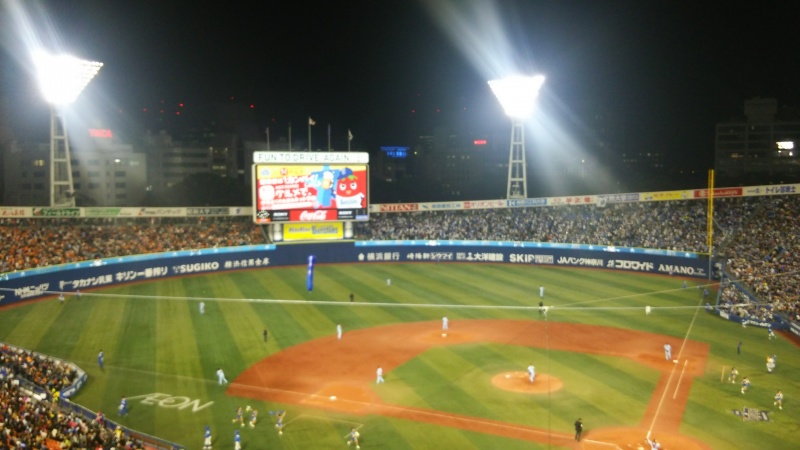


Yokohama Stadium is in the heart of the city and there are plenty of things to do in the area. The field was initially made out of turf, but DeNA recently purchased the stadium and grass will be installed for the 2016 season and beyond. The infield dirt was only on the bases, home plate and the mound while everything else was brown or green colored turf. 

The seats will change from orange to blue for 2016 with a renovation happening. Yokohama Stadium is a huge bandbox ballpark in NPB, making it easy to hit a home run. With 94 meters (308.4 ft) at the edge of left and right field, the ball can easily reach the crowd.  It's a hitter's heaven, or a pitcher's nightmare. 

===

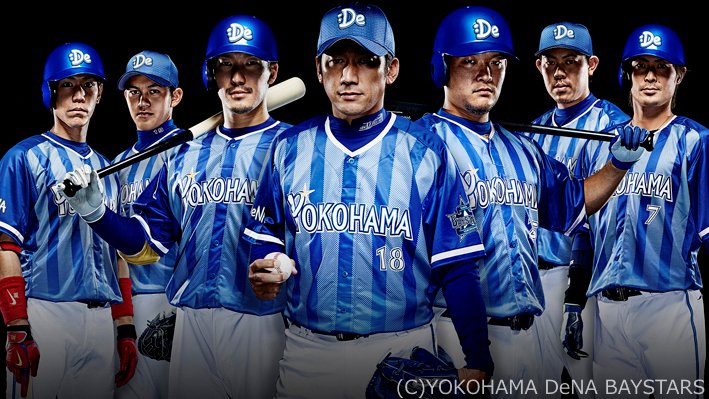
Primary Uniforms: Made by Descente 


Home design
New road design for 2016

===

Mascot: "DB Starman"


DB Starman might look like a cat with a star face, but it's a hamster, with the title being a play on words. “Hamster” is pronounced hamasutaa in Japanese. "Hama" comes from YokoHAMA, and "sutaa" is from STAR, with the Japanese pronunciation of the English word "star" being sutaa. When combined, this sounds very similar to the Japanese pronunciation of hamster, although the spelling in Japanese is different.

===

Cheer Song:

"Atsuki hoshi-tachi yo" (熱き星たちよ) "Passionate Star"


 The Baystars themesong had copyright issues in the USA on youtube, but here's the older version where it says "Yokohama" instead of "DeNA" if the above video doesn't work.  Same tune, just different instrumentals besides DeNA's name not in there. 


If you're really looking for the current version, here's the most recent.  


 ===

Ōendan Songs: (Theme song at 00:00, 2015 Player songs at 0:20, Other theme songs at 5:38, Lucky 7 Atsuki hoshi-tachi yo at 7:05, Chance songs at 8:02, Other themes songs at 10:45.


===

 MLB Comparison: Toronto Blue Jays

Prior to 2015, the Blue Jays and Baystars both shared the longest playoff droughts among their respective leagues of MLB and NPB. Both teams broke their droughts in 2015 and 2016, respectively. Even with the Blue Jays being in the postseason for 2015, it's still worthy of a comparison because of how the ballpark is built. It's easy to hit a home run in Yokohama combined with the same difficulty of giving one up. Like Toronto, power numbers become inflated.  

===

Notable former MiLB and MLB players who played for the Baystars: 

As Taiyo Whale: Jim Tracy, Leon Lee

As Yokohama Baystars: Jose Lopez, Guillermo Moscoso, Glenn Braggs, Hideki Okajima

===

Notable former Whale and Baystars to played in MLB:

Takashi Saito, Kazuhiro Sasaki, Tomo Ohka

Note: Takashi Saito was declining when he left the Baystars in 2006, but revived his career in MLB with the Los Angeles Dodgers.  

===

Verdict: 

Why you root for them: Because you like one of the best kept secrets in Japan. Yokohama is most likely forgotten among the average Joe. There are plenty of things to do in Yokohama besides watch baseball, with plenty of tourist attractions and places to shop. The Baystars also have a very nice stadium for a team that is sometimes an afterthought. 

You also sympathize with teams that haven't been good in a long time, hoping they can be great again.  Lastly, you love offense because home runs can soar and even leave the ballpark

===

Why you don't root for them: As mentioned earlier, the Baystars have the longest postseason drought in NPB, with their last year being in 1998 when winning the Japan Series. They have not appeared in a playoff game since and their last third place finish was in 2005. However, the playoffs in the Central League used to only have two teams, so their four 3rd place finishes from 1999-2001 and 2005 have all been for naught.  

Opposing teams will often outnumber the home crowd when Yokohama plays a game. While some teams have a limited visitor's section, Yokohama lets anyone in and it leaves room for others to take over. In contrast to the top, if you dislike high scoring affairs, this team isn't for you for the stadium reasons mentioned above.  

===

Other teams in the series: 


===

Follow us on Twitter @GraveyardBall

Friday, January 15, 2016

The Oakland A's/Seibu Lions Series: Roger Repoz


The next player in our series was viewed as the "Next Mickey Mantle," but it didn't work out that way.

========

Tenures: 1966-1967 with the Kansas City A's, 1973 with the Taiheiyo Club Lions

Statistics with the A's: 141 games, 470 PAs, .222/.320/.377 13 HRs, 42 RBIs, 1.2 bWAR

Statistics with the Lions: 66 games, 215 PAs, .220/.312/.430 12 HRs, 12 HRs, 30 RBIs

A Bellingham, Washington kid, through and through, Roger Repoz looked the part and brought all the hype. Playing for his hometown school of Western Washington University, he put a small school on the map and MLB scouts paid attention. Back in the days before the Amateur Draft, like everyone, Roger Repoz signed a $6,000 bonus with the New York Yankees, that amount of money was the limit for any amateur player, that was until the very next year when that limit became $200,000.

Yankees scouts, media and fans were mesmerized by the look of the 6'3", 190 pound left handed outfielder. His blonde crew cut made him look like Mickey Mantle and it was thought he could do it all. Dick Young of the New York News quoted the Yankees third baseman Clete Boyer the following, "He really has quick wrists, the quickest I've seen. When he finds out what he can do with it, watch out." speaking on Repoz's potential. The Yankees scouts saw him as the heir apparent to Roger Maris rather than Mantle, but the "second Mantle" was just something that the fans couldn't take out of their minds.

Repoz was only supposed to have one real weakness, and that was that he struck out too much. Which Dick Young comments with "That's like saying a guy has a perfect body, except he has a heart condition." and that's a bit harsh. That certainly speaks to the attitudes about baseball in the time of the 1960s.

After doing plenty of damage in the minors with his power, and the Yankees seeing Maris and Mantle wearing down with injuries, Repoz made his MLB debut in 1964 for Yogi Berra's Yankees. That Yankee team would go to the World Series that year, and lose to the St. Louis Cardinals in 7 games. During his time in the Bronx, Repoz really never got a chance to play extensively with Maris and Mantle still manning the Yankees outfield.

Repoz enjoyed Yankee Stadium's dimensions that allowed him to show decent home run totals in part time duty, but he struggled against left handed pitching and was too enthralled with that short porch in right field. His time as a Yankee ended in 1966, when he was traded to the Kansas City A's for Fred Talbot and Billy Bryan. The trade was a nothing for nothing trade, and that was probably relief for the Kansas City A's who constantly got smoked on trades with the Yankees (most notably: Roger Maris for Don Larsen in 1959).

There's not much to say about Repoz's time in Kansas City, he was the last player to wear No. 9 before Reggie Jackson, who became the reason why the number is retired by the A's organization.

Repoz loved playing in New York and he admitted that he wished the trade had never happened. And who could blame him, playing for the Kansas City A's was never a fun time. At that point, the A's were a young team that was on the rise and Alvin Dark was hoping that he could get Repoz to reach the potential that he once had. With Reggie Jackson being called up to Kansas City in 1967, he'd last one and a half years in Kansas City before being traded to the California Angels for Jack Sanford and Jackie Warner in another nothing for nothing trade.

Repoz would have this to say about the now late A's manager Alvin Dark, "Dark was a good manager, (but) a strange man."

Repoz's best years in the big leagues would come in Orange County, he'd establish himself as a decent part time player who was a real three true outcomes hitter. In fact, during his MLB career, Repoz would have 13 Adam Dunn hat tricks (games in which a batter hits a home run, draws a walk, and strikes out all in the same game). It's a remarkable accomplishment for someone who only had 82 career home runs.

In fact, that wouldn't be the only interesting tidbit from his big league career. In 1971, Roger Repoz would become the first player to have a batting average below .200 and an OPS above .700. Even more impressively, Repoz would go three seasons without grounding into a single double play. All in all, it was between 1,018 plate appearances without a GIDP.

He'd have one 2.0+ bWAR season in 1968 and that would be the extent of his major league career. He was traded to the Baltimore Orioles in 1972 for Jerry DaVanon (the father of Jeff DaVanon) and that would be the end of his MLB career, since the Orioles had no plans for him.

With nowhere to go, Repoz looked to Japan for a rebirth in his stifled career. The Taiheiyo Club Lions from Fukuoka were the ones who came calling. They signed him for $124,000 which nearly doubled his annual salary during his career in the big leagues. Repoz had admitted that things weren't easy in Japan, since most guys couldn't take the Japanese way of baseball, but he also said, "They paid for everything; I had an apartment year round; the lifestyle was good; they treated you like a star."

Large expectations were placed on Repoz from the Lions fans, but he had subpar year with the team which saw his days with the club end after 1973. In 66 games with the Lions, he hit .220 with 12 home runs for his lone season in Fukuoka.

The Yakult Swallows were the ones who took a chance on him the year after, and they were rewarded for doing so.


He'd deliver home run totals of 25, 27, 36, and 22 as Repoz took advantage of the band box that is Jingu Stadium. Repoz thought Jingu was like playing in a sandlot since it was an all sand infield at the time, but that didn't bother his performance. In 1975, he was the only foreign player in the Central League's Best IX (Nine).

Repoz's career ended after the 1977 season and he was out of baseball at the age of 36. A failed prospect in every way, Repoz was able to have a decent career in Japan hitting 122 career home runs there.

Repoz played during two fruitless time periods for the A's and Lions. He's the last guy in this series with that unfortunate misery.

Special thanks to SABR.org and baseball-reference for all the information. I couldn't find any pictures of Repoz from his Lions days, if anyone has any, please share them.

===


Others in the series: 


===

Follow us on Twitter @GraveyardBall

Thursday, January 14, 2016

Majestic to supply Seibu Lions uniforms for 2016

Photo credit: Baseball King
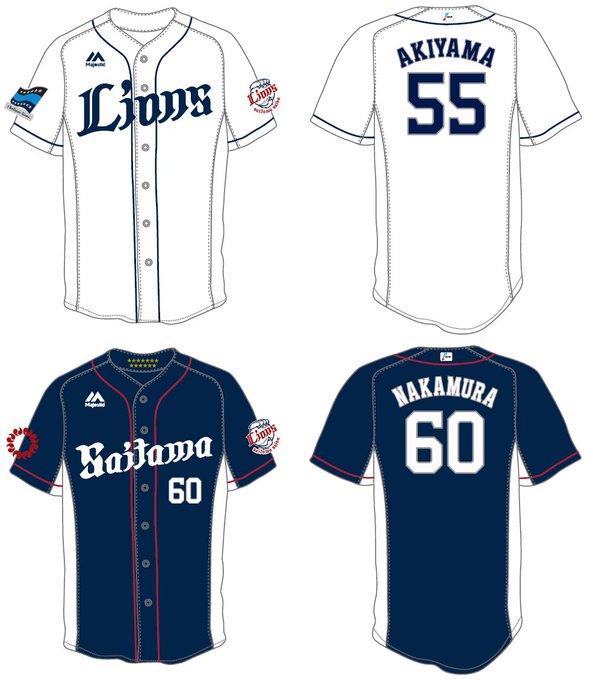
The Saitama Seibu Lions will have a new uniform supplier for the 2016 season. After previously being supplied by Nike since 2001, they will now be under contract with Majestic. This news was announced last fall, but a recent leak showed the new uniforms on Baseball King.

Majestic has been the uniform supplier for all 30 MLB teams, making the on-field authentic (pro model) jerseys. Recently, they dipped into the NPB market when signing an agreement with the Rakuten Golden Eagles last year.

Other teams to sign a new agreement with Majestic includes the Tokyo Yakult Swallows and Fukuoka Softbank Hawks.

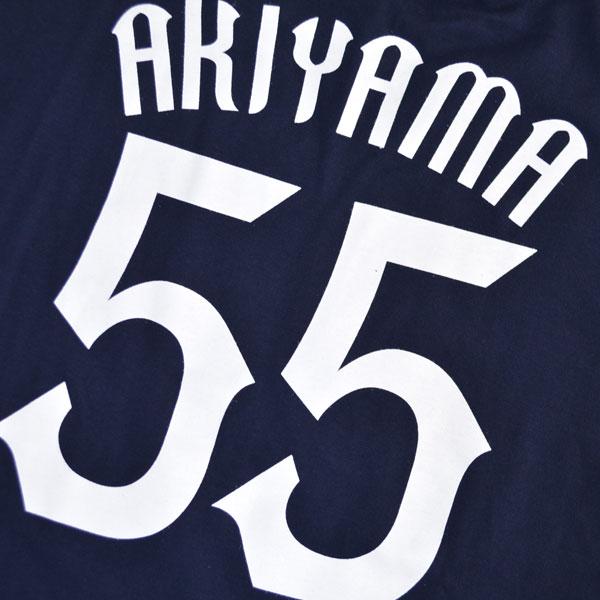
This font has disappeared after one season.  
The most notable difference in the new Lions uniforms is how the numbers and name do not have the similar font that they had under their rebrand from 2009-2015. The accents in the numbers and name are gone, given a more generic "block" look.

I personally consider this to be a downgrade compared to what was there before. The name and number font had an identity, which resembled the "Lions" font on the front of the jersey.

A full jersey unveiling will be announced on January 29th at the Seibu Lions kickoff.  What do you think of these changes?

===

Follow us on Twitter: @GraveyardBall

Wednesday, January 13, 2016

Your guide to adopting an NPB team part 8: Fukuoka Softbank Hawks (福岡ソフトバンクホークス)

Fukuoka Softbank Hawks (福岡ソフトバンクホークス)

Update: Found this post? Here's a 2020 edition.

The Fukuoka Softbank (ソフトバンク) Hawks were originally owned by Nankai electric railways in 1938. Their most famous title was as Nankai Hawks from 1947-1988 and they were based in Osaka before their move to Fukuoka. When moving to Fukuoka, their ownership changed and they were called the Fukuoka Daiei Hawks from 1989-2004. Daiei is a famous supermarket chain in Japan. The Hawks were then-sold to Softbank to become the Fukuoka Softbank Hawks, a title they've held since 2005.

Ownership: Softbank Corporation

Softbank is not a bank, but a telecommunications company that also specializes in e-commerce, media, technology internet services, phone services and more. The title of "Softbank" is more a reference to a bank of software and technology, hoping to continue to develop electronics in the future.

They are in partnerships with Yahoo!, E-trade, Ustream and other companies. Softbank also gives their employees jerseys of the Hawks and they can wear them at work in Japan. (Sorry, they don't do the same for USA employees, per source, but they are aware of the baseball team).

===

League: Pacific

===

Payroll Rank in 2015: 1


The Hawks have a very good structure in stashing talent, but also keeping their players long term with a better payday. Their budget has not been a problem with several free agents also coming to Fukuoka. This number should stay at the top, but they don't build their team with just free agency.

===

Location/Stadium: Fukuoka Yafuoku! Dome, in Fukuoka


Fukuoka is the northern part of Kyushu Island, which is the southern portion of Japan. With Fukuoka being closer to the equator than the rest of the big cities that have NPB teams, the climate is tropical and more humid. There are several festivals and other cultural things in Fukuoka. In terms of food, Hakata (Tonkatsu) Ramen is a specialty of the area.

It's a short flight away from South Korea, which makes it an easy getaway spot. For those who've played Pokémon, Generation III  of Ruby, Sapphire and Emerald representing the Hoenn region is based out of Kyushu, where more surfing and water is featured.


The Fukuoka Yafuoku! Dome (Yahoo! Auction Dome) is the only retractable roof stadium in NPB. However, the Hawks don't play outdoors too often in a given season with complaints about noise from the neighboring areas combined with the cost to open and close the roof. Here's a photo of how it looks when the roof is open.


One of the biggest thing to note about this dome is how they added a closer fence in 2015, where it's also shorter than the previous dimensions. Private seats were including in both left and right field with centerfield represented by a line, which is shorter than before. The home run total doubled last year with the Hawks allowing and hitting more than their track record shows.

===

Primary Uniforms: Made by Majestic for 2016

Home design
Road design
Notice that Softbank puts their "=" logo on the cap and on the sleeves, if not the pants stripes.  You can read more about it here.

===

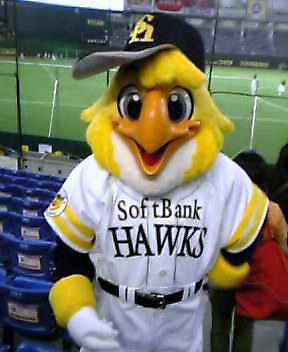
Mascot: Harry the Hawk

\
If we want to be technical, there's a family of Hawk mascots, where you can see a photo of them here.

===

Cheer song: Izayuke Wakataka Gundan (いざゆけ若鷹軍団) "Let's Go Young Hawks"


This song was used when they were Fukuoka Daiei Hawks, but the lyrics obviously changed to Softbank when ownership changed in 2005. A retro version can be heard here.

===

Ōendan Songs: Full list of 2015 Player songs at 00:00, Scoring songs at 11:48, Izayuke Wakataka Gundan at 12:38, Chance songs at 14:38


Note: You'll either really like or really be annoyed by their style of chanting. Some tunes are repetitive and redundant, while others can be slow/dull. Even their general theme after a base hit or a basic out feels like it's on a loop just to rub it in on the opponent.  There are also "dance motions" while holding the plastic bats/megaphones. 

===

MLB Comparison: St. Louis Cardinals

The Hawks are homegrown, but always contenders. Not only are they built for the present, but the future as well with plenty of talent stocked up. They have a second team, but they build up talent even for a third team, working from within. It helps when they have a high payroll to spend on free agents like Lee Dae-Ho and Dennis Sarfate.

At the time of this writing, Softbank has 17 Pacific League pennants and has won a Japan series in three of the last five years (2011, 2014 and 2015). They should be good for both the now and long term.

===

Notable former MiLB and MLB Players:

As Fukuoka Daiei/Softbank Hawks: C.J. Nitkowski, Dennis Sarfate, Jason Standridge, Rick Van Den Hurk

As Daiei Hawks: Goose Gossage, Willie Upshaw, Chris Haney, Kevin Mitchell, Bobby Thigpen

As Nankai Hawks: Don Blasingame (as both a player and later manager, Don Buford, Carlos May

===

Notable Hawks who played in MLB: 

Kenji Johjima, Tadahito Iguchi, Muenori Kawasaki

===

The Verdict

Why you root for them: The question is, why don't you root for them? They're consistently a contending team and they should have more Japan Series titles from their dominance in the 1950s and 1960s, but ran into the Yomiuri Giants where they would only have a handful. The Hawks should be a winning team in the Pacific League with great talent at both pitching and hitting. Their ballpark even helps with a shorter fence, making it a bandbox, but dangerous no matter what because the power numbers of their lineup goes up.  

Rather than be loyal to a big city in Tokyo or Osaka, Fukuoka is the sixth largest in Japan and brings a different taste of the country to light. Best yet, their fans shows up on a nightly basis and are always loud inside the dome. Lucky 7 is always packed and everyone buys a balloon for the break and song.  

===

Why you don't root for them:  You would dislike having high expectations every year with the fear of coming up short. The Hawks primary weakness has been stranding runners on base for numerous years. When Sadaharu Oh was the manager, the team found creative ways to exit in the postseason. Oh is currently the chairman of the Hawks.  

Tickets would be expensive and corporate priced compared to other teams. Maybe it's also too easy to be a fan of them, because they've been contenders every year. Not much reward compared to liking a team that has struggled more times than not. 
 
===

Other teams in the series: 


Yomiuri Giants (巨人)


=== 

Follow us on Twitter: @GraveyardBall

Tuesday, January 12, 2016

The Oakland A's/Seibu Lions Series: Taylor Duncan


Japan was often used as nothing more than a pit stop for American ballplayers, especially in the 70s and 80s. Taylor Duncan is no exception.

================

Tenures: 1978 with the Oakland A's and 1980 with the Seibu Lions

Statistics with the Oakland A's: 104 games, 348 PAs, .257/.296/.335, 2 HRs, 37 RBIs, -0.1 bWAR

Statistics with the Seibu Lions: 64 games, 247 PAs, .235/.271/.452, 14 HRs, 36 RBIs

Among ballplayers who came out of Sacramento, very few had the potential that Taylor Duncan had. He graduated out of Grant Union High School, the same school that Carolina Panthers LB Shaq Thompson came out of as a baseball and football star (though Shaq chose football and not baseball, as he was drafted in both). Duncan was affectionately referred to as "Dunc" by all who knew him, and he caught the eye of scouts who saw him lead Grant Union to the No. 1 ranking in the entire state of California.

It was the Atlanta Braves who selected him with the 10th overall pick in the 1971 Amateur Draft. Scouts saw him as a good comparison to Joe Morgan, which warranted the high draft pick.

In his first minor league season, Duncan would break his ankle sliding into second. This injury has been called the reason why he never lived up to his full potential.

The Braves traded him early on in his minor league career to the Baltimore Orioles in a franchise turning trade that saw Duncan and Earl Williams sent to Baltimore, while Davey Johnson, Pat Dobson, Roric Harrison, and Johnny Oates were sent to Atlanta. Atlanta hit a home run on this deal, and Duncan was left to find himself in the Orioles organization.

He'd prove to be a solid gap hitter in his first couple of seasons in the Baltimore Orioles organization, and he'd reach AAA Rochester at the age of 22, but ended up spending the next three seasons in Rochester. He didn't do enough to make it to Baltimore. He would finally make it to the Major Leagues during the end of the 1977 season, as the St. Louis Cardinals claimed him off waivers from the Orioles and played him in 8 games, which saw him hit one home run.

His time in the Cardinals organization would prove brief, as the Oakland A's would select Duncan in the Rule 5 Draft following that season. The A's gave him an extended shot to succeed in 1978, playing mostly third base. This Oakland team was a dark time in the A's history, as they started the year with Jack McKeon managing the team before Charlie Finley fired him and replaced him with Bobby Winkles. The A's would finish a 69-93 record.

Though Duncan held his own at times in the big leagues, he was released by the A's following that season. He'd then bounce around the minor leagues with the Detroit Tigers, Orioles, Cleveland Indians, Pittsburgh Pirates and Toronto Blue Jays organizations from 1979-1980.

Then he talked to his friend Leon Lee, who was already a few years into a tremendous career in Japan. His high school friend told him about the great amounts of money he was making and how much success he was having. Leon, the father of Derrek Lee, had revitalized his baseball career and he felt the same could be done with Duncan.

After hitting .290 in AA Knoxville while in the Blue Jays organization in 1980, he signed with the Seibu Lions for 12 million yen in the middle of the year. Upon arrival, in his first intrasquad game, he hit a home run.

Then-Lions manager Rikuo Nemoto was excited about Duncan's talent and knew that he was a gap hitter, but he expected a lot out of this former major leaguer. Duncan was concerned that bats were so much more expensive in Japan. As a result, he was worried about breaking them in practice.

Duncan seemed to enjoy his time in Japan as he loved the food and wanted to build a house there. He even tied the team record in home runs when the season began, but it was his poor fielding that forced the Lions to part ways with their Gaijin. Lions coaches cited a knee injury that forced him into poor reaction times.

The 1980 season was the second in Lions' history as Seibu Lions, as they moved in 1979 from Fukuoka to Tokorozawa in what was then known as Seibu Stadium. (The dome roof wasn't installed until the 1990s). This Lions team was almost an expansion team, coming off multiple team sales and name changes after a Black Mist scandal and they were starting over.

With the Lions having so much trouble with errors from their previous season of 1979, they signed Steve Ontiveros from the Chicago Cubs to replace him at third base.

To add insult to injury, Duncan received his release right when his family arrived in Japan. He'd then head to Mexico to finish his career.

How he did in Mexico is not clear as no statistics have been recorded. He ended up playing for four teams between 1981-1983. And at the age of 30, his baseball career was presumably over.

There's not much information about what Duncan did after his career. Sadly, in 2004, he died of a stroke at the age of 50 in Asheville, North Carolina. Leon Lee stayed friends with Duncan until his death and said that, "A lot of people in Sacramento cared about Taylor... It's a shocker, I wish I had gotten there in time... I don't think Duncan ever realized how good he really was. Duncan made coming to the ballpark fun and the players around him better."

Taylor McDowell Duncan's final resting place is in Asheville, North Carolina which is a beautiful part of the country in the Appalachian Mountains. Sadly, Duncan's career will always be remembered for what could've been.

Special thanks to the Sacramento Bee, sponichi.co.jp, and baseball-reference. Special thanks also goes out to Mizuho Miyazaki for translation help.  

===

Others in the series: 


Roger Repoz

Jim Tyrone

Esteban German 

Bert Campaneris  

Hiram Bocachica


Jesus Aguilar

===

Follow us on Twitter @GraveyardBall

Monday, January 11, 2016

Your guide to adopting an NPB Team part 7: Tōhoku Rakuten Golden Eagles (東北楽天ゴールデンイーグルス)

Tōhoku Rakuten Golden Eagles (東北楽天ゴールデンイーグルス)


Update: Found this post? Here's a 2020 edition.

The Tōhoku Rakuten (楽天) Golden Eagles were formed in 2005 after the Orix BlueWave and Kintetsu Buffaloes merged into Orix Buffaloes at the end of 2004. A new location would have its own baseball team as a result.

Ownership: Rakuten

Rakuten (pronounced Rock-U-Tin) is an E-Commerce company who can help in banking, brokering, travel and more. It's also one of the most useful internet shopping websites in Japan, where it can ship internationally. Rakuten.com can be the Japanese equivalent of Amazon for buying goods. They also sell plenty of NPB merchandise for those who want it.

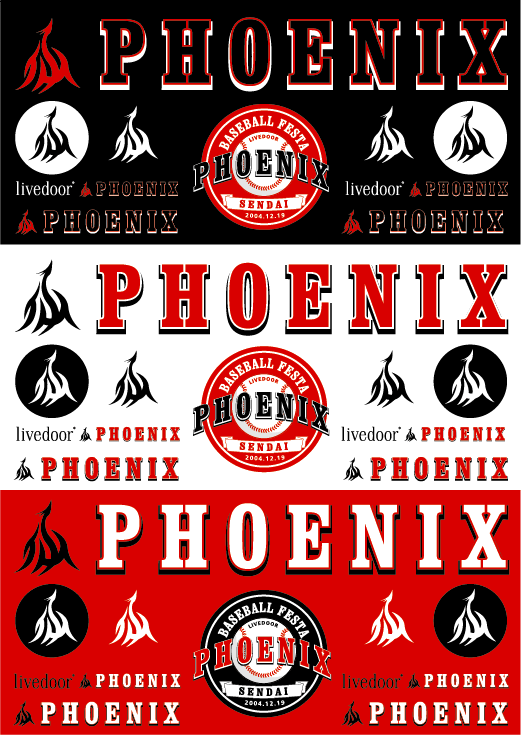
Livedoor came in second place as the potential owners of the new baseball team in Sendai and their title would've been the Livedoor Phoenix

===

League: Pacific

===

Payroll rank in 2015: 11

One should note that about ¥500 million ($4.1 million) separated the 5th highest payroll from the last. This number could go up, with the recent foreign signings they made. 

===

Location: Rakuten Kobo Stadium Miyagi, in Sendai, Miyagi.  

\
  
Sendai was the largest city affected by the 2011 Tsunami Earthquake. It's the biggest city in the entire Tōhoku region, which is the northern part of the Honshu island. Tōhoku (東北) actually translates into "Northeast". While the Tsunami happened nearly five years ago, people in the area are still affected today without a home and the disaster resonates every March 11. 

Hot springs are also a big deal in Tōhoku, if not the more basics food in the North. It's a very earthy part of the country and they even promote being green in their alternate uniforms


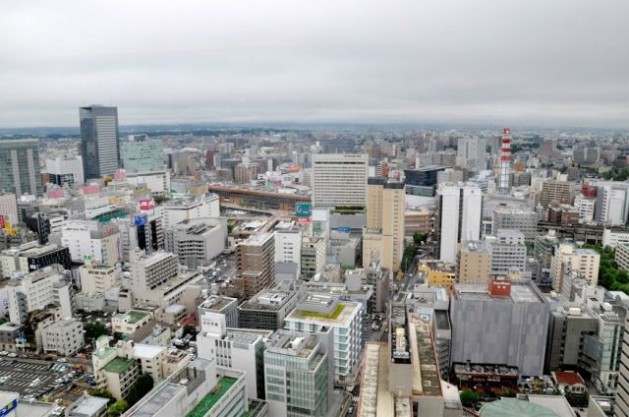
Kobo Stadium is one of only two primary outdoor ballparks in the Pacific League. It used to have the title of "Kleenex Stadium" at one point. The dimensions are symmetric and the field features grass with a normal infield dirt.  Not only this, but they even installed a Ferris Wheel in LF and the photo above shows a view from the top.


 Traditionally, this is a pitcher's ballpark. This stadium was once a home to the Lotte Orions, the former name of the Chiba Lotte Marines.

This building was damaged by the 2011 Tsunami Earthquake, forcing the Eagles to play away from their home temporarily.

===

Primary Uniforms: Made by Majestic

Home design

Road design
===

Mascot: Clutch (left) and Clutchina (right) and 


The Golden Eagles are named after a species of eagles that live in the Tōhoku mountains.  

===

Cheer song:  Habatake Rakuten īgurusu (羽ばたけ楽天イーグルス) "Flap your wings, Rakuten Eagles"


 ===

 Ōendan Songs: Opening Theme at 00:00, limited list of player songs at 0:38, General themes at 4:57,  Habatake Rakuten at 6:00, E-Dream at 6:53, limited number of Chance songs at 7:27


===

MLB Comparison: Arizona Diamondbacks

Rakuten is a young expansion team like the Dbacks and they won a championship in their first decade of existence. After going through growing pains as a new franchise, the 2013 season proved to be the magical one where they won the Japan Series in their ninth season.  

===

Notable MiLB and MLB Players to play for Rakuten: 

Andruw Jones, Casey McGehee, Gaby Sanchez, Zealous Wheeler, Kevin Youkilis, Kazuo Matsui, Marty Brown (as a manager), Takashi Saito

Notable Eagles to play in MLB: 

Casey McGehee, Hisashi Iwakuma, Masahiro Tanaka

Note: Iwakuma had an interesting case, where he refused to play for the merged Orix Buffaloes, so he was traded to Rakuten as a result. 
===

Verdict

Why you root for them: 

Because they're a young team who brings a different energy to baseball. The Tōhoku region is simple in its own way and you can relate to this, rather than being corporate like Tokyo. It's remote and far from the larger markets, but it's a simplistic side of Japan. Also, you could be a fan of Tanaka and wondering where he dominated before playing with the New York Yankees in MLB. He went 24-0 in his final season with Rakuten before they won their first championship in 2013.

Rakuten has also worked to provide more service in English besides buying products off their website. There's an exclusive English radio featuring several teachers in the area providing commentary on each home game for the Eagles. You can download the Rakuten.FM App for Android or iPhone as well as listen through a PC here. If you have twitter, you can talk to the commentators through the hashtag #EagleStation.  

===

Why you don't root for them:

There is a lack of tradition or history due to being an expansion team. Through 11 seasons in team history, they've only been to the postseason twice, which means less winning.  

===

Sunday, January 10, 2016

Kenta Maeda signing with the Dodgers is a dream come true

Photo credit: John SooHoo
The Los Angeles Dodgers officially signed Kenta Maeda (MaeKen) to an 8-year contract worth $25 million in base salary alone on Thursday afternoon.

His deal is incentive based, where he could make more than $100 million if he reaches all of them.  There are no opt out clauses in his contract, making his deal one of the most team friendly for a high spending Dodgers team.

This signing, in many ways has things come full circle for the Dodgers. While Hideo Nomo was not the first professional player to come from Japan, he was the one who put the country's brand of baseball on the map.


The Dodgers are most remembered for breaking the barrier as Brooklyn Dodgers with Jackie Robinson in 1947. However, they've had plenty of diversity over the years going international, from Fernando Valenzuela to Nomo to Chan Ho Park and even Hong-Chih Kuo.

While there are plenty of player from Latin American countries today, the Dodgers have had an identity to find players from Asia. Park, Kuo, Takashi Saito, Hiroki Kuroda, Chin-Lung Hu and Hyun-Jin Ryu have all taken different paths, but made their way to the Dodgers.

In comes Kenta Maeda, where he was rewarded with the Hiroshima Carp announcing they would post him a year earlier than expected last fall. Multiple teams were interested, but the Dodgers gave him a lengthy contract for eight years.

In reality, Maeda is barely making more than what he made with the Carp from base salary alone. He was willing to take a gamble on himself to earn every dollar with incentives in his contract.

Sure, there is always a risk with signing an unknown player who will be making new adjustments to MLB. This includes playing every five days rather than once a week to seeing more talented hitters with pop.

However, the Dodgers have needed rotation depth in the last year after they had multiple spot starters to take the season. Clayton Kershaw remains the ace while Alex Wood, Brett Anderson, Scott Kazmir and Ryu should complement Maeda. Prior to signing MaeKen, the Dodgers had an all-lefty rotation, which wouldn't be good for balance. The Dodgers will also get Brandon McCarthy back coming off Tommy John surgery in the middle of the season.

Maeda may not be the most flashy pitcher on the team, but the Dodgers have acquired good depth for the short and long term with several prospects downstairs in AAA.

There are several paths Maeda can take in his time with MLB. It's clear how his contract is not about money, but a fulfilling a dream of being a pitcher in the big leagues.

He'll be motivated to make a name for himself in the Majors and now he'll be part of a rotation with balance. The question is, does he become a solid mid rotation starter like Kuroda or a bust like Kazuhisa Ishii? 

The best part, will be fans in Japan cheering him on and possibly staying up late (for day games) to watch him like they do for Masahiro Tanaka, Yu Darvish and others. Dodgers gear should be aplenty in Japan from previous history, but now they'll have a new face in Maeda playing for them.

It's not only a dream for Maeda, but one for us here at Graveyard Baseball with history coming full circle on the Dodgers signing players from Asia. The Dodgers uniform is arguably one of the best in all of sports and Maeda looks as fine as the rest of them.

===

Follow us on Twitter @GraveyardBall